 Add to Chrome
 Add to Firefox
 Add to Edge
Exploring Bottlenecks in VLM-LLM Navigation: How 3D Scene Understanding Capability Impacts Zero-Shot VLN
May 14, 2026
Zero-shot vision-and-language navigation (VLN) has gained significant attention due to its minimal data collection costs and inherent generalization. This paradigm is typically driven by the integration of pre-trained Vision-Language Models (VLMs) and Large Language Models (LLMs), where VLMs construct 3D scene graphs while LLMs handle high-level reasoning and decision-making. However, a critical bottleneck exists in this system: current 3D perception models prioritize pixel-level accuracy, directly conflicting with the strict computational limits and real-time efficiency demanded by embodied navigation. To address this gap, this paper quantifies the actual impact of 3D scene understanding capability on VLN performance. Based on typical VLM-LLM frameworks, we propose statistical success rate (SR) upper bounds for two core subsystems: 1) the slow LLM planner, which relies on topological mapping semantics, and 2) the fast reactive navigator, which utilizes spatial coordinates and bounding boxes to execute LLM decisions. Evaluations using state-of-the-art 3D scene understanding models validate our proposed bounds and reveal a perception saturation phenomenon, indicating that improvements in perception accuracy beyond a certain threshold yield diminishing returns in navigation success. Our findings suggest that 3D scene understanding for VLN should pivot away from strict pixel-level precision, prioritizing instead navigation-relevant core vocabularies and accurate bounding box proportions.

AutoResearchBench: Benchmarking AI Agents on Complex Scientific Literature Discovery
Apr 28, 2026Autonomous scientific research is significantly advanced thanks to the development of AI agents. One key step in this process is finding the right scientific literature, whether to explore existing knowledge for a research problem, or to acquire evidence for verifying assumptions and supporting claims. To assess AI agents' capability in driving this process, we present AutoResearchBench, a dedicated benchmark for autonomous scientific literature discovery. AutoResearchBench consists of two complementary task types: (1) Deep Research, which requires tracking down a specific target paper through a progressive, multi-step probing process, and (2) Wide Research, which requires comprehensively collecting a set of papers satisfying given conditions. Compared to previous benchmarks on agentic web browsing, AutoResearchBench is distinguished along three dimensions: it is research-oriented, calling for in-depth comprehension of scientific concepts; literature-focused, demanding fine-grained utilization of detailed information; and open-ended, involving an unknown number of qualified papers and thus requiring deliberate reasoning and search throughout. These properties make AutoResearchBench uniquely suited for evaluating autonomous research capabilities, and extraordinarily challenging. Even the most powerful LLMs, despite having largely conquered general agentic web-browsing benchmarks such as BrowseComp, achieve only 9.39% accuracy on Deep Research and 9.31% IoU on Wide Research, while many other strong baselines fall below 5%. We publicly release the dataset and evaluation pipeline to facilitate future research in this direction. We publicly release the dataset, evaluation pipeline, and code at https://github.com/CherYou/AutoResearchBench.
SFCo-Nav: Efficient Zero-Shot Visual Language Navigation via Collaboration of Slow LLM and Fast Attributed Graph Alignment
Mar 02, 2026Recent advances in large vision-language models (VLMs) and large language models (LLMs) have enabled zero-shot approaches to visual language navigation (VLN), where an agent follows natural language instructions using only ego perception and reasoning. However, existing zero-shot methods typically construct a naive observation graph and perform per-step VLM-LLM inference on it, resulting in high latency and computation costs that limit real-time deployment. To address this, we present SFCo-Nav, an efficient zero-shot VLN framework inspired by the principle of slow-fast cognitive collaboration. SFCo-Nav integrates three key modules: 1) a slow LLM-based planner that produces a strategic chain of subgoals, each linked to an imagined object graph; 2) a fast reactive navigator for real-time object graph construction and subgoal execution; and 3) a lightweight asynchronous slow-fast bridge aligns advanced structured, attributed imagined and perceived graphs to estimate navigation confidence, triggering the slow LLM planner only when necessary. To the best of our knowledge, SFCo-Nav is the first slow-fast collaboration zero-shot VLN system supporting asynchronous LLM triggering according to the internal confidence. Evaluated on the public R2R and REVERIE benchmarks, SFCo-Nav matches or exceeds prior state-of-the-art zero-shot VLN success rates while cutting total token consumption per trajectory by over 50% and running more than 3.5 times faster. Finally, we demonstrate SFCo-Nav on a legged robot in a hotel suite, showcasing its efficiency and practicality in indoor environments.
InfoFlow: Reinforcing Search Agent Via Reward Density Optimization
Oct 30, 2025Reinforcement Learning with Verifiable Rewards (RLVR) is a promising approach for enhancing agentic deep search. However, its application is often hindered by low \textbf{Reward Density} in deep search scenarios, where agents expend significant exploratory costs for infrequent and often null final rewards. In this paper, we formalize this challenge as the \textbf{Reward Density Optimization} problem, which aims to improve the reward obtained per unit of exploration cost. This paper introduce \textbf{InfoFlow}, a systematic framework that tackles this problem from three aspects. 1) \textbf{Subproblem decomposition}: breaking down long-range tasks to assign process rewards, thereby providing denser learning signals. 2) \textbf{Failure-guided hints}: injecting corrective guidance into stalled trajectories to increase the probability of successful outcomes. 3) \textbf{Dual-agent refinement}: employing a dual-agent architecture to offload the cognitive burden of deep exploration. A refiner agent synthesizes the search history, which effectively compresses the researcher's perceived trajectory, thereby reducing exploration cost and increasing the overall reward density. We evaluate InfoFlow on multiple agentic search benchmarks, where it significantly outperforms strong baselines, enabling lightweight LLMs to achieve performance comparable to advanced proprietary LLMs.
OmniGen2: Exploration to Advanced Multimodal Generation
Jun 23, 2025In this work, we introduce OmniGen2, a versatile and open-source generative model designed to provide a unified solution for diverse generation tasks, including text-to-image, image editing, and in-context generation. Unlike OmniGen v1, OmniGen2 features two distinct decoding pathways for text and image modalities, utilizing unshared parameters and a decoupled image tokenizer. This design enables OmniGen2 to build upon existing multimodal understanding models without the need to re-adapt VAE inputs, thereby preserving the original text generation capabilities. To facilitate the training of OmniGen2, we developed comprehensive data construction pipelines, encompassing image editing and in-context generation data. Additionally, we introduce a reflection mechanism tailored for image generation tasks and curate a dedicated reflection dataset based on OmniGen2. Despite its relatively modest parameter size, OmniGen2 achieves competitive results on multiple task benchmarks, including text-to-image and image editing. To further evaluate in-context generation, also referred to as subject-driven tasks, we introduce a new benchmark named OmniContext. OmniGen2 achieves state-of-the-art performance among open-source models in terms of consistency. We will release our models, training code, datasets, and data construction pipeline to support future research in this field. Project Page: https://vectorspacelab.github.io/OmniGen2; GitHub Link: https://github.com/VectorSpaceLab/OmniGen2
Dynamic Datasets and Market Environments for Financial Reinforcement Learning
Apr 25, 2023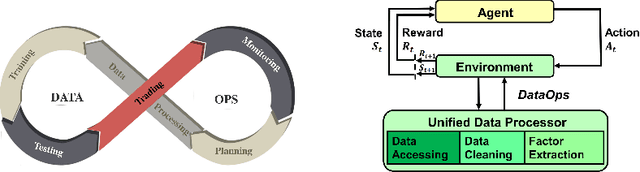
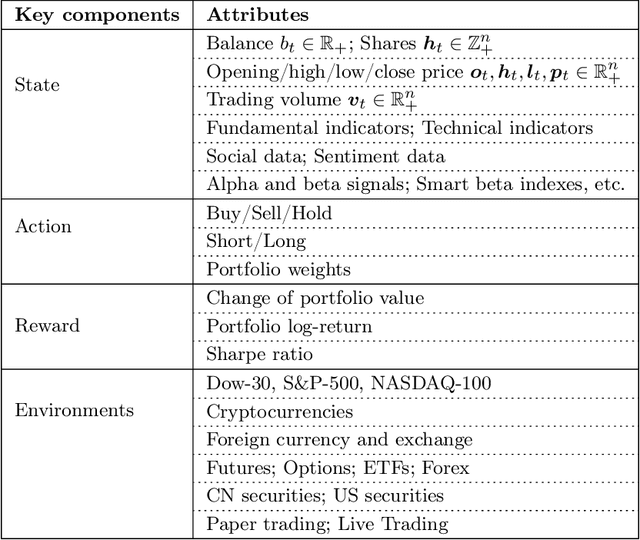
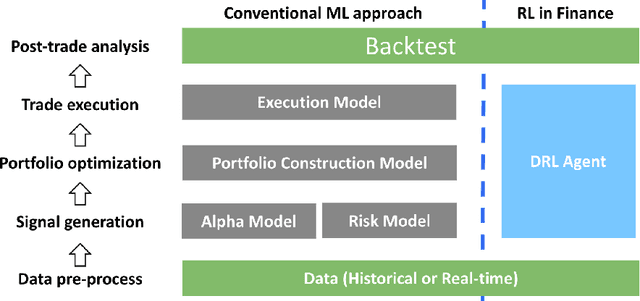
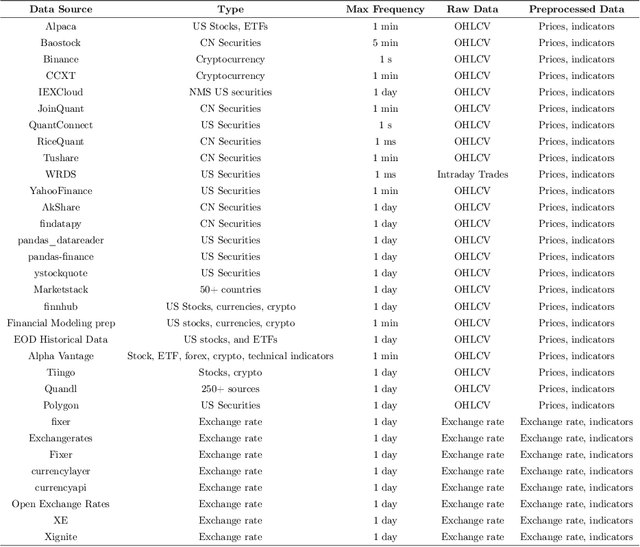
The financial market is a particularly challenging playground for deep reinforcement learning due to its unique feature of dynamic datasets. Building high-quality market environments for training financial reinforcement learning (FinRL) agents is difficult due to major factors such as the low signal-to-noise ratio of financial data, survivorship bias of historical data, and model overfitting. In this paper, we present FinRL-Meta, a data-centric and openly accessible library that processes dynamic datasets from real-world markets into gym-style market environments and has been actively maintained by the AI4Finance community. First, following a DataOps paradigm, we provide hundreds of market environments through an automatic data curation pipeline. Second, we provide homegrown examples and reproduce popular research papers as stepping stones for users to design new trading strategies. We also deploy the library on cloud platforms so that users can visualize their own results and assess the relative performance via community-wise competitions. Third, we provide dozens of Jupyter/Python demos organized into a curriculum and a documentation website to serve the rapidly growing community. The open-source codes for the data curation pipeline are available at https://github.com/AI4Finance-Foundation/FinRL-Meta